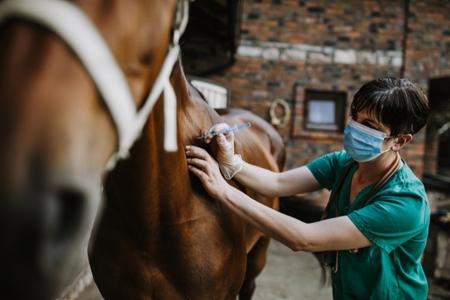
Why can't I hold my pet for the doctor during procedures?
For the safety of owners, pets, and veterinary staff alike, pets should be restrained by our trained assistants during uncomfortable procedures. Many pets will actually struggle more when held by an owner, because they know them and expect them to let go. Our assistants are familiar with firm but gentle restraint, and know how to safely hold your pet without injuring or releasing it. Additionally, there have been several lawsuits filed against other clinics when owners have been bitten or scratched by their own pet; for liability reasons as well as safety reasons, we cannot allow non-employees to restrain pets for most procedures.
Why does my pet have to be in a carrier or on a leash?
There are many reasons for this. Primarily, it is because in order to create a safe environment for all of our clients and patients; it is important that our lobby be calm and orderly. Even though your dog is very nice and would never bite, the cat in the corner can't possibly know that. And you don't know if the other dog in the lobby is as friendly as yours; when your dog runs up to him to make friends and gets bitten as a result, no one will be pleased.
Also, please keep in mind that we are located right next to the highway. It takes only a few seconds for an unrestrained pet to rush out the door when someone else enters or leaves, and it would be entirely too easy to end up with an unrestrained pet on the highway.
Can't you just sell me medications? Why do I need to bring my pet in?
State law requires that prior to dispensing medication to any animal, we establish what is termed a Veterinarian-Client-Patient relationship. This means that we must have seen the pet within a reasonable time (this varies by state, but generally means 6-12 months), and we must have evaluated the pet for the problem for which we are dispensing medication. The risk of misdiagnosis and inappropriate or ineffective medication is quite high if the veterinarian has not actually seen and evaluated the pet; many conditions show similar signs but require different treatments. In order to provide the best possible care for your pet, and also to keep our licenses intact and ourselves out of jail, we cannot dispense medication without seeing the pet. For more information about this topic, please see this American Veterinary Medical Association page.
How do I become a veterinarian myself?
Similarly to becoming a human doctor, obtaining a DVM (Doctor of Veterinary Medicine) degree entails first getting a Bachelor's degree or other 4 year degree. Following that is acceptance to one of the 28 US accredited Colleges of Veterinary Medicine for another 4 years of specific schooling. There is no 2 year program or night-school option to become a veterinarian. Be wary of online offers claiming otherwise; these are invariably scams.
Is it safe to feed human foods to my pet?
Most human foods are not, in and of themselves, toxic to most pets. However, feeding human food is a very easy way to get a pet much too fat - remember that a balanced diet for one species is not necessarily balanced for another. Even for foods that are acceptable to feed, a reasonable portion for you may be 10 - 12 times what a reasonable portion would be for your small dog.
Some specific foods that should not be fed to pets:
Everyone has been told that chocolate can be dangerous; as with most things, this is a dose-dependant relationship. The darker the chocolate, the larger the quantity ingested, and the smaller the pet, the more likely there is to be a problem. Thus a single piece of dark chocolate ingested by a pet rat may be fatal, whereas a large dog may suffer nothing more than diarrhea from eating a whole pan of brownies. So don't panic if your dog sneaks a chocolate chip cookie, but don't make it a habit to feed any animal chocolate; even in small amounts, you can't pretend it's health food! Signs of chocolate toxicity are vomiting, diarrhea, muscle tremors, or seizures.
Macadamia nuts can cause a temporary paralysis in dogs. This occurs only in dogs, and has never been reported to be fatal. It resolves within 24 hours, but can be pretty scary. So don't share this treat with Fido.
Grapes and raisins have been reported to cause sudden kidney failure in some dogs. The "toxic principle" is currently unknown, and this does not seem to be a dose-related issue; some dogs eat raisins regularly with no problems, and some dogs have died from a single snack of grapes. Because this reaction is not predictable, we advise against feeding grapes or raisins to dogs.
Onions and garlic can cause an oxidative hemolytic anemia in cats. Say that again in English, right? What happens is that cats who ingest onions or garlic may go through a systemic reaction in which their red blood cells fracture and can no longer transport oxygen. This is dose dependent, so the more they eat the higher the risk of problems.
Espresso or coffee beans, especially the chocolate covered beans, are never an appropriate treat in any amount. Even a small amount of caffeine may result in hyperactivity, agitation, and aggression. Large amounts of caffeine can cause seizures or death.
Milk, contrary to popular belief, is not generally a good thing to offer pets. Once an animal (or human) is weaned and stops ingesting milk on a regular basis, the body stops producing the necessary enzymes to digest milk sugar (lactose). The bacteria that aid in digestion of milk are quickly out-competed and replaced by different beneficial bacteria. Once these processes occur, ingesting large amounts of milk results in fermentation of the milk sugar in the intestinal tract, and can lead to diarrhea, cramping, and gas. Effectively, any animal that has not had milk on a regular basis should be considered lactose intolerant.
Sugar-free candies, gum, and toothpaste often contain xylitol as a sweetener. In humans, xylitol appears to be innocuous and is basically ignored by the body. In dogs, however, it can trigger insulin release, resulting in a sudden and severe decrease in blood sugar, hypoglycemic crisis, and liver damage.
How do I get my dog registered as a Service Animal?
The short answer is that you probably can't.
Service Animals are legally defined by the Americans With Disabilities Act of 1990 and are trained to meet the specific disability-related needs of their handlers who have disabilities. Federal laws protect the rights of individuals with disabilities to be accompanied by their Service Animals in public places. Your personal pet will not be considered a Service Animal no matter how well behaved it is at home unless it has been acquired from a registered Service Animal organization, or sent to one for the appropriate training. The majority of pets are not qualified for these programs, and do not / will not successfully complete the rigorous training involved.
Simply sewing a bright colored vest for your pet does not qualify it as a Service Animal, and there have been several instances of untrained or poorly trained pets passed off as Service Animals who have caused serious legal issues for their owners; see the next question for examplesof this.
If you have a disability and think you would benefit from a Service Dog, contact an appropriate organization, such as the following:
Dogs for the Deaf Guide Dogs for the Blind Dogs for the Disabled
What's the difference between a Service Animal and a Therapy Animal?
Therapy Animals are different than Service Animals, and do not require the intensive training of Service Animals. However, they do not qualify for all of the same ADA access rights as Service Dogs.
Here are links to information about a recent case on this topic, in which a dog that had not completed the requisite training to be a Service Dog bit a child. The owners of the dog have claimed that the dog was a Service Animal.
Molly and Ava Molly and Ava, the rest of the story
What are your thoughts on microchips?
Please see our microchip information page, as this is much too long a topic to answer here. Hint: we approve of them.
When should I vaccinate my pet?
Puppies should be vaccinated against parvo and distemper every 3 - 4 weeks, beginning at 6 - 8 weeks old and ending at 16 weeks old. After that, they should be vaccinated every 1 - 3 years, depending on their age and risk level.
Kittens should be vaccinated against upper respiratory and panleukopenia viruses 2 - 3 times between the ages of 8 and 16 weeks. This vaccination should be repeated after 1 year, and then every 3 years. Outdoor cats should also be vaccinated for Feline Leukemia; this vaccine is given twice, 1 month apart, and then boostered yearly. Both cats and dogs can be vaccinated for rabies as young as 3 months old. The first rabies vaccine is good for 1 year, subsequent vaccines are good for 3 years (in Washington; check with your local veterinarian or State Veterinary Office if you live in a different state, as some have different requirements).
What age should my pet be to be spayed or neutered?
We usually recommend a spay (ovariectomy or ovariohysterectomy) or neuter (castration) be performed around 6 months of age, unless you plan to breed the dog or cat. This allows time for the pet to do much of their growth and development prior to surgery, while still catching them young enough to avoid heat cycles, accidental pregnancies, and troublesome behaviors such as urine marking. There is really no such thin as "too old" to consider a spay / neuter. For female animals, we strongly recommend spaying when you retire your pet from breeding to avoid the risk of potentially fatal uterine infections.
I've heard that letting a dog lick a wound helps it heal. Is that true?
No. In fact all mouths, and dog mouths in particular, are generally full of many kinds of bacteria. Letting any animal lick a wound is a very efficient way to get an infection in that wound. Additionally, continual licking causes physical irritation to healing tissue, removes protective scabs and re-opens wounds, significantly delaying healing.
Concerningly, a recent article published on AllPetNews claimed that a study showed that dog saliva can halve healing time. This statement, however, was based on misinterpretation and exageration of the actual study results, in which isolated, sterilized, and concentrated Nerve Growth Factor was used to treat wounds. Ignoring the differences between a sterile wound treatment and a dog licking wounds is misleading, potentially dangerous, and just bad science.
For a more thorough explanation of this article and the study it misleadingly referenced, please see the Worms and Germs Blog.
We make every effort to charge reasonable and fair prices while providing the best care available. We are aware of the economic diversity of our clients, and do our best to develop individual treatment or referral plans suiting each case. Estimates for work-up and treatments are available upon request.
We are unfortunately unable to offer delayed billing; payment is expected at time of services. We offer a number of ways to pay for your pet's veterinary needs. We accept cash, checks, Visa, Mastercard, and Discover.
Have you considered pre-paying on your account in small increments to cover your pet's future medical needs? Contact us, and we'll let you know how.
We also accept Care Credit, an interest-free payment program designed exclusively for medical and veterinary expenses. You can apply for Care Credit online before your appointment, or one our receptionists will be happy to help you with your application the day of your visit.
Finally, there are many companies out there that provide pet health care insurance. Use your favorite search engine to get more information.
For general questions, or to sign up for email reminders for your pet's vaccinations, please feel free to contact us via email.
For general questions, or to sign up for email reminders for your pet's vaccinations, please feel free to contact us at inquiries@chewelahveterinaryclinic.com.